4.2
Building Ego-Centric Datasets
for Physical AI
Training physical AI systems requires data that no benchmark dataset provides. Ego-centric video - first-person recordings of tasks performed in real environments - is the closest proxy to how a robot or spatial agent experiences the world. We describe our approach to collecting, annotating, and structuring ego-centric and embodied datasets at scale, and the principles that guide what we capture and why.
1. The Data Problem in Physical AI
1.1 Why Physical AI Data Is Hard to Collect
The data problem in physical AI is qualitatively different from the data problems that earlier generations of language and vision models faced. You cannot scrape it from the internet. You cannot generate it synthetically at the fidelity that real deployment requires. Every data point requires a human, a camera, a physical environment, and a task sequence - and every one of those has to be logged, synced, and verified before it is usable.11. Synthetic data can close distribution gaps for rare or dangerous events, but for core manipulation and navigation competencies, real-world data remains essential.
This means that the teams building frontier physical AI systems are spending enormous fractions of their engineering capacity on data infrastructure rather than on model development. Data collection pipelines, annotation tooling, quality filtering, and dataset curation are full-time problems for teams that nominally exist to build robots. We exist to take those problems off their plate.
1.2 Why the Ego-Centric Perspective Matters
Most existing robot datasets are captured from third-person cameras - a fixed overhead or external view of a robot completing a task. This is useful for studying behavior from the outside. It is not useful for training the robot’s own perception.22. Third-person data teaches an observer; first-person data teaches a participant. See the EPIC-Kitchens 100 dataset for a large-scale study of what ego-centric annotation enables.
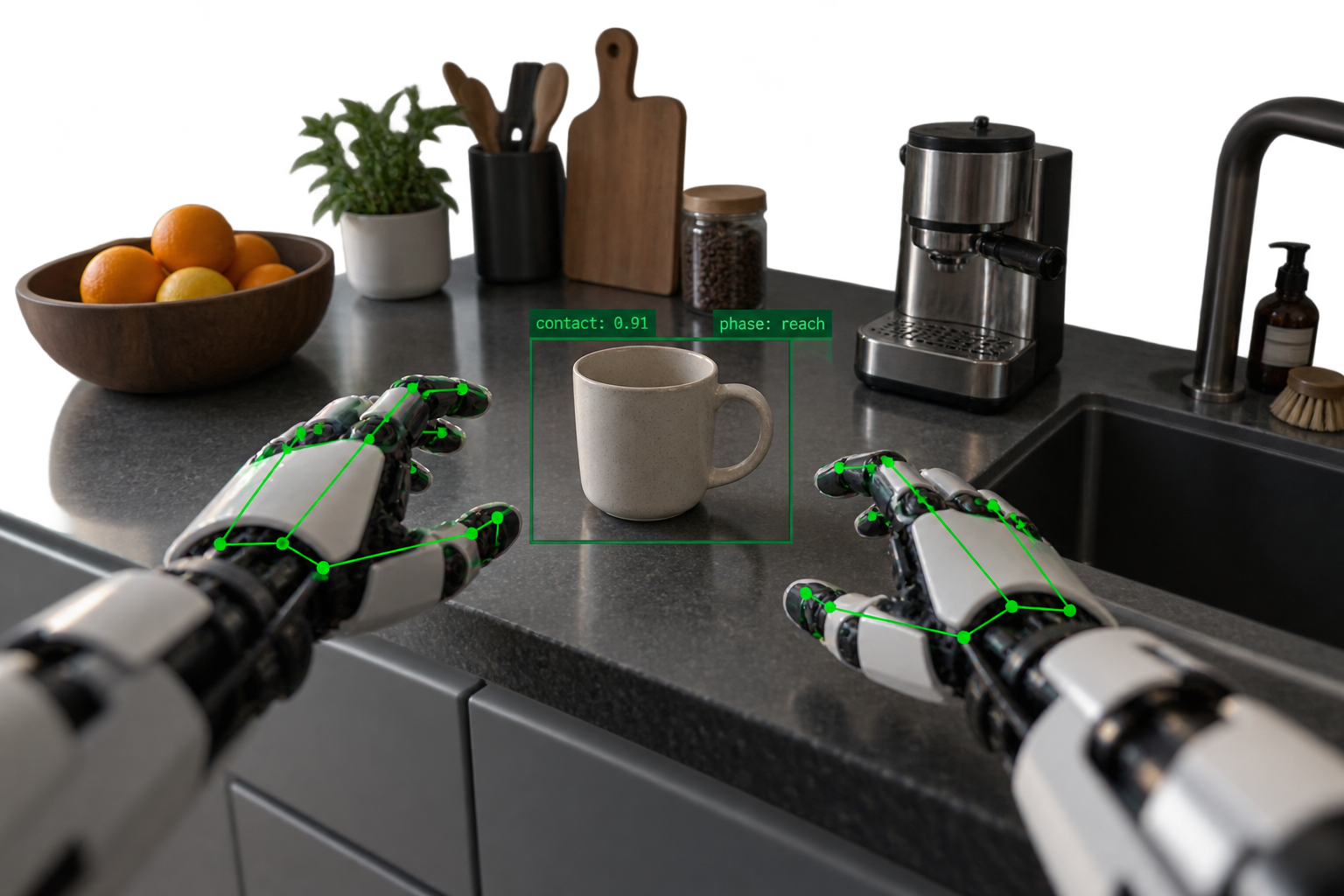
An ego-centric dataset captures the world from the agent’s perspective: what the robot sees as it reaches for an object, what the hand looks like as it grasps and manipulates, how the scene changes as the agent moves. This is the visual substrate that the model needs to close the perception-to-action loop in real deployment.
2. Our Collection Approach
2.1 Environments
We collect data across three primary environment categories: domestic (kitchen, laundry, general household), light industrial (assembly, packaging, material handling), and unstructured outdoor (navigation, tool use in variable terrain). Each environment category presents a different set of perceptual challenges and requires different annotation schema.
2.2 Task Categories
Within each environment we organize tasks into four competency categories:
- Manipulation: grasping, placing, cutting, assembling. Tasks where the agent must apply precise force to an object at a specific location.
- Articulation: opening doors, drawers, containers. Tasks where the agent must identify a movable joint and apply directional force across its range of motion.
- Sorting and organizing: folding, stacking, arranging. Tasks where the agent must track multiple objects and move them into a target configuration.
- Navigation: moving between locations while maintaining awareness of obstacles, static structure, and dynamic elements.
3. Scale, Quality, and Annotation
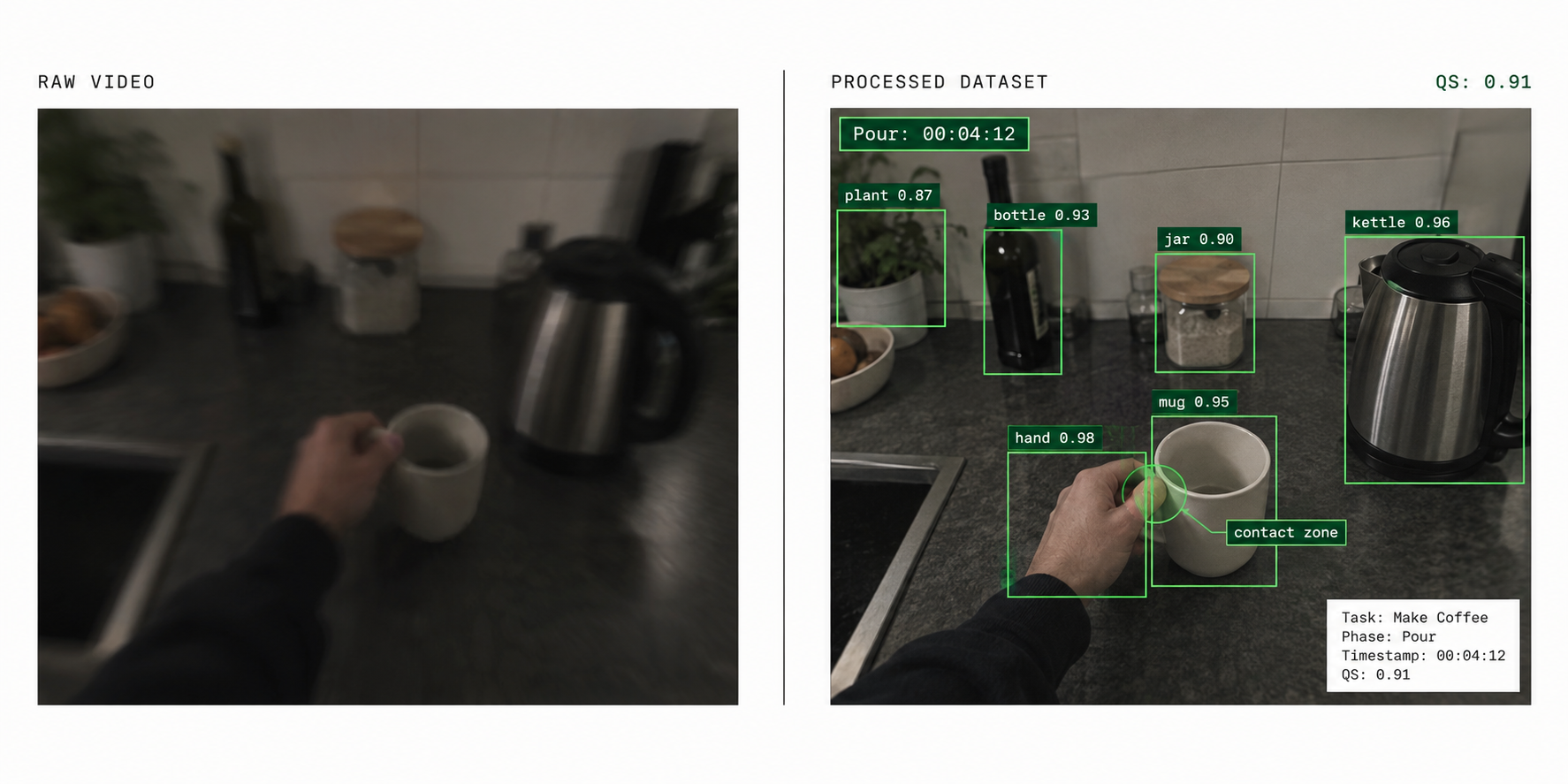
Raw video is not a dataset. Getting from recorded footage to training-ready data requires segment extraction, task boundary detection, quality filtering, and frame-level annotation. Our annotation pipeline produces per-frame object labels, hand-object contact events, task phase labels, and failure annotations where the demonstrator made a recoverable error.33. Failure annotations are particularly valuable for training recovery behaviors - a model that has never seen a grasp failure cannot learn to recover from one.
4. What’s Next
Our first ego-centric dataset release covers domestic manipulation tasks across kitchen and laundry environments. We are building the annotation schema for light industrial tasks and expect to begin collection in early 2027. Frontier labs interested in dataset access or co-collection partnerships can reach us at founders@generalmachines.ai.